The Essential Guidebooks for PNW Landowners to Restore Forest Health after Megafire
The Pacific Northwest is experiencing an increasing number of catastrophic wildfires that are hotter and lasting longer than ever before. In the past, these megafires were rare, and often confined to public lands. More and more, they are also devastating communities and private landowners.
Sustainable Northwest has seen many private forest landowners grapple with what to do to restore their land after wildfire. Who do they call? Should they replant? What should they plant? When should they plant? Who can help them? How do they fund restoration?
Kailyn Klotz in our forest program saw this personally after one significant fire in 2023.
"In August 2023, my family's home was one of hundreds lost in the Gray Fire in Medical Lake, Washington,” Klotz said. She saw firsthand how challenging it was for neighboring landowners to know what the steps to recovery were. For themselves, but also for their properties.
“Until recently, there hasn’t been much guidance for what to do or who to call after a fire,” says Klotz. An increasing number of resources, such as After the Fire Washington, a centralized hub for post-fire information, are emerging to help meet the wide range of needs faced by those impacted. And when it comes to guidance specifically for post-fire forest restoration, that’s where the wildfire team at Sustainable Northwest saw an opportunity to help.
Introducing a guidebook for private forest landowners
They created two new, easy-to-read Post-Fire Restoration Guidebooks specifically for private forest landowners in eastern Washington and western Oregon. These guidebooks are more than just instruction manuals; they are complete resources designed to guide landowners in their post-fire restoration.
Tailored to the landscape. The eastern Washington guidebook tackles restoration approaches for the dry, eastern portion of Washington State, using examples from the 2023 Oregon and Gray fires around Spokane. The western Oregon guidebook, on the other hand, is tailored to west of the Cascade Mountains, which is wetter. Where Sustainable Northwest has hands-on experience helping private forest landowners recover from the 2020 Labor Day Fires in western Oregon.
Written for everyone. Whether you have .5 or 500 acres of wildfire impacted forestland, these guides walk you through common federal, state, and local resources and assistance programs. They also list important considerations regarding forestry laws, financing, and climate implications.
Realistic timeline. Landscape restoration is often a multi-year process, with many different steps. Our guidebooks are realistic about the landscape recovery timeline and helps landowners create detailed and effective plans for long-term forest health.
Climate-adapted practices. In a warmer, dryer climate, the goal of post-fire restoration isn’t always to recreate what existed before the fire, but to establish forests that can survive and thrive in future conditions. That means incorporating climate-informed practices, such as selecting resilient species, adjusting planting strategies, and planning for hotter, drier environments, to support long-term forest recovery.
Tools to make informed decisions. The guides and the professional contacts listed within will help you answer the big questions: Who can help me? Should I replant? When to plant? What to plant? Where to plant? Etc.
Help is available. The most important takeaway of the guidebooks is that private landowners do not have to recover alone. Our guides connect you with primary resources like the USDA Natural Resources Conservation Service, Washington Department of Natural Resources, Oregon Department of Forestry, state university extension programs, and local conservation districts.
“We really want to emphasize that there are partners and resources available to help private forest landowners restore their properties,” Klotz said. “Healthy, private forestlands provide resources we all benefit from – clean air, clean water, and wildlife habitat. Which is why effective and climate-adapted post-fire restoration is so important.”
The guidebooks are already coming into use, proving their essential role in helping landowners take their first, critical steps toward a recovered, resilient forest.
The guidebooks are available here:
Sustainable Northwest Post-Fire Restoration Guidebooks
Why Sustainable Northwest?
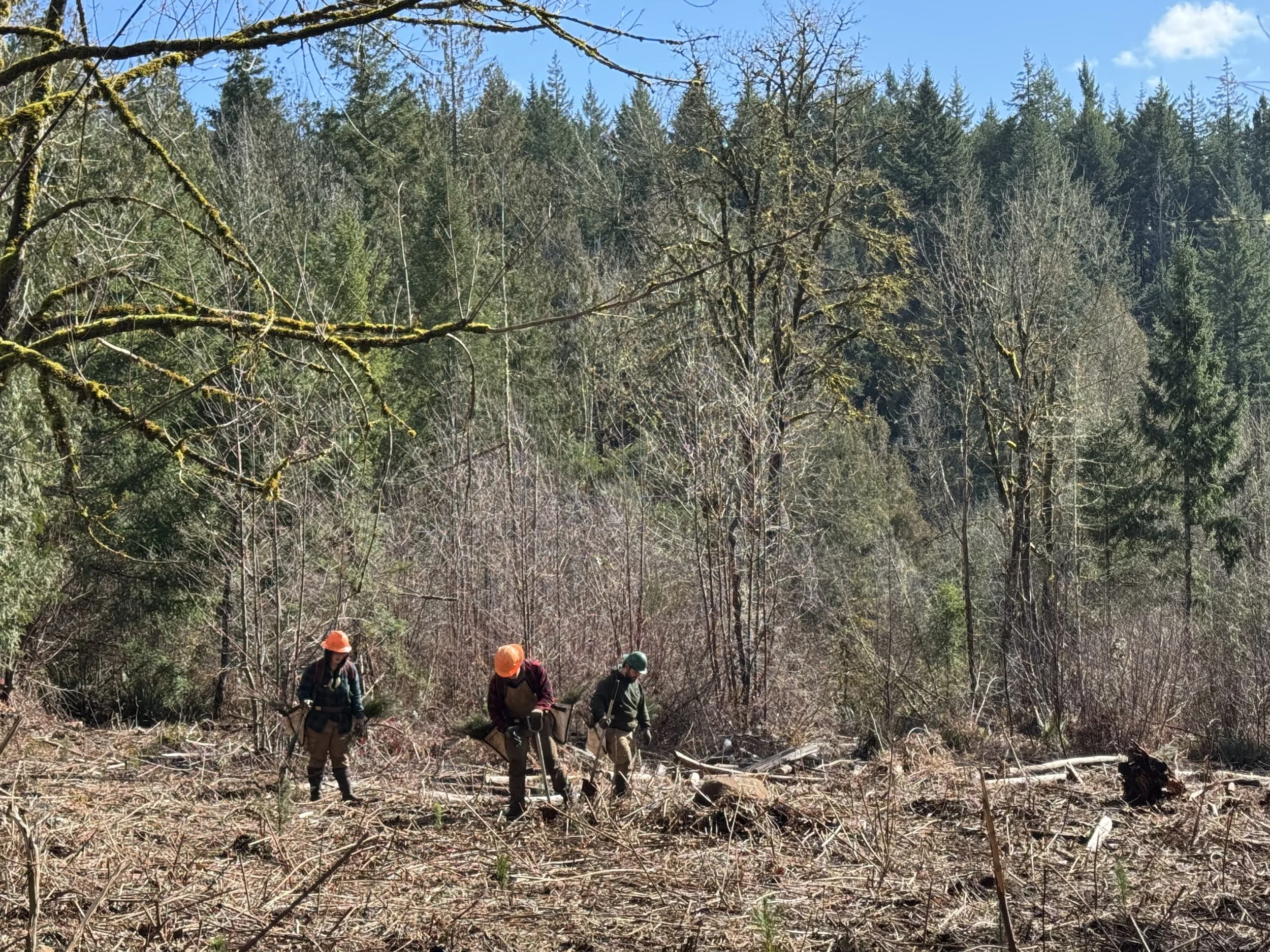
Post-fire recovery can be bureaucratic and complicated, and Sustainable Northwest is uniquely equipped to help landowners navigate it. We launched a post-fire recovery program for small, private forest landowners in Western Oregon affected by the 2020 Labor Day Fires. This has given us a complete, 360-degree view of what assistance is out there, the paperwork involved, and the restoration knowledge needed. We handle every step, from securing funding and working with planners to back-ordering the right seedlings. From getting the money to getting the trees in the ground—that’s what we do.
Plus, Sustainable Northwest is in the process of launching a new Pacific Northwest Reforestation Network with American Forests and WA Department of Natural Resources. This network is designed to connect everyone involved in the reforestation pipeline—private and public land experts—to share best practices, funding news, and successful approaches, making sure this vital work goes smoothly.
These projects are being funded by a generous grant from the Alumbra Foundation, WA Department of Natural Resources, and University of Oregon Ecosystem Workforce Program as well as by donors to Sustainable Northwest that want to support post-fire restoration efforts in Oregon and Washington. Together we can help families like the Klotzes recover from wildfires and restore the landscapes we all love.
Want to support our work? Make a one-time or recurring donation here.