
7 Things We Know About Restoring Wet, Westside Forests in Oregon and Washington
SNW and partners share stories and innovation to improve forest health during a recent tour of the Willamette National Forest

Group photo from Willamette National Forest tour, June 2026. Photo credit: Sustainable Northwest.
Standing on the shores of Detroit Lake, a reservoir on the North Santiam River, you can still see the scars six years after the 2020 Labor Day Fires – megafires that burned uncharacteristically hot and fast. Facing north with your back to the reservoir, the Beachie Creek burn scar runs across the left side (northwest) and the Lionshead scar to the right (northeast). The two fires merged in the middle, due north of the reservoir, to create a conflagration that destroyed thousands of buildings, killed five people, and burned hundreds of thousands of acres.
In June 2026, we spent a day in the field with scientists, state and federal agencies, and local NGO partners on the Willamette National Forest. We visited three sites:
one showing the burn scars from two nearby 2020 Labor Day megafires;
one showing a stand of trees thinned recently (the Dry Beard thinning project); and,
one showing a stand thinned about 10 years ago (the Cub thinning project).
Both thinning projects were planned to improve forest health and wildlife habitat while producing timber and reducing fire risk.
Here's what we learned:
1. The 2020 Labor Day Fires weren't a fluke, but they weren't inevitable either.
On Labor Day weekend 2020, five megafires ignited across Oregon in a 48-hour window, driven by historic east winds that gusted up to 75 mph. Together, those fires burned more than one million acres, destroyed over 5,000 homes and businesses, and ended with 11 lives lost statewide. The five largest fires — Lionshead, Riverside, Beachie Creek, Holiday Farm, and Archie Creek — each grew by more than 100,000 acres during that 48-hour period, with the majority of fire growth occurring west of the Cascade Mountains in areas that do sometimes burn, but not very often and not usually with the intensity of the Labor Day Fires.
Dr. James Johnston, a fire ecologist at the University of Oregon who joined us in the field, is direct about what happened: it was a confluence of high winds and exceptional drought, an ignition pattern that is historically unusual but not unprecedented. The fires burned almost as much forest west of the Cascade crest in two weeks as in the previous five decades combined – more specifically, about 840,000 acres burned in two weeks compared to 1M acres in the previous five decades combined, according to research led by Johnston and published in Ecosphere.
That scale is alarming. But Johnston and his colleagues have also shown that it didn't have to be this bad — and that with the right management, future fires don't have to be either.


2. Westside forests have always burned.
One of the most important findings from recent research is that westside forests are not the fire-free landscapes many assumed them to be. Forests on the west slope of Oregon's Cascade Range experienced fire much more often between 1500 and 1895 than had been previously thought, according to Johnston and his team’s research.
To reconstruct that history, Johnston and colleagues cross-dated a total of 147,588 tree rings and identified 672 “cambial” injuries (injuries just below the bark) — 479 of which were fire scars. This allowed them to reconstruct 130 different fire years that occurred before a federal policy of fire suppression went into effect in the early 20th century.
What the research on these historical fire scars reveal is that before fire suppression became the norm, this wet, westside forest experienced fire. And each ridge had its own fire history, creating a mosaic pattern. Some areas burned frequently at low severity; others experienced less frequent but more intense fire. We know large fires affected approximately 20% of the west side (specifically in 1850 and 1902 in the western Cascades and Coast Range of Oregon), but small fires occurred regularly as well. The forest was a dynamic, diverse forested landscape with frequent fires of varying size.
3. Indigenous peoples were active stewards of these forests, and their forced removal from large areas of land changed everything.
The tree rings don't just show fire. They show when fire stopped.
Johnston interprets the extraordinary tempo of fire in some stands, and the climate patterns associated with fire there, as evidence of Indigenous fire stewardship. The researchers documented some of the most frequent fire return intervals ever recorded in the Pacific Northwest. And it is consistent with what Indigenous leaders have said for years: that Tribes were stewarding this land with fire and tree removal for millenia. Their goals were often to grow bigger trees for shelter, and to maintain meadows that support edible plants and game plus grasses for basketmaking.
Humans have occupied the southern part of what is now the Willamette National Forest for at least 10,000 years, with a variety of Indigenous cultures – including the Molalla, Kalapuya, Tenino, Wasco, Klamath, Northern Paiute and Cayuse – using the area for trading, hunting, gathering, and more.
The research also shows what happened when Indigenous people were forcibly relocated to reservations in the 1850s. Fire abruptly ceased. The landscape that followed – dense, closed-canopy, fire-suppressed – is what we now call "natural." It isn't. It is the result of more recent, western management choices that have reduced fire on the landscape.
This is not a small footnote. The Willamette National Forest sits on ceded Tribal land. The Confederated Tribes of Warm Springs, Confederated Tribes of Grand Ronde, and Confederated Tribes of Siletz Indians hold treaty rights here, and the Forest Service has trust and co-management responsibilities to these Tribal Nations. Tribal knowledge of fire existed long before western science caught up. Now the science is confirming what Tribal nations have always known: intentional burning and tree thinning was — and can again be — a tool for maintaining healthy, resilient landscapes that provide multiple benefits including timber, wildlife habitat, carbon storage, and food sources.
4. Decades of limited harvest left westside forests dense, uniform, and vulnerable.
After the era of active Indigenous land management ended, the forests went through a different kind of change. The early 20th century brought heavy industrial harvest — clearcuts replanted almost exclusively with Douglas-fir, plus suppression of all fire. Then, harvest declined sharply under the Northwest Forest Plan in the 1990s, and much of the federal forest entered a long period of very little active management – no clearcuts, but also very little tree removal at all and no prescribed burning or beneficial fire.
The result: overcrowded stands with hundreds of trees per acre, dense canopies that prevent light from reaching the forest floor, and almost no structural diversity. “The Willamette National Forest is not water limited. It is light limited,” said Trent Seager, director of science for Sustainable Northwest, on the tour.
Without light, the forest lacks alder, maple, cedar, ponderosa pine, and hemlock that belong in a healthy westside forest. Missing is the understory — the beargrass, wildflowers, and native shrubs that thrive when light reaches the ground. Missing is the habitat complexity that wildlife, including the northern spotted owl, actually needs.
The Northwest Forest Plan focused on preventing the harvest of large, old trees. This was and is still necessary, but after 30 years we now know that in addition to preventing harvest of large old trees, we need active management that mimics fire and removes younger trees, thus allowing large trees to grow larger, letting more light reach the forest floor so that shrubs, grasses, and other wildlife habitat can grow, and removing heavy fuel loads that increase the risk of megafire in an age of warming temperatures and drought.
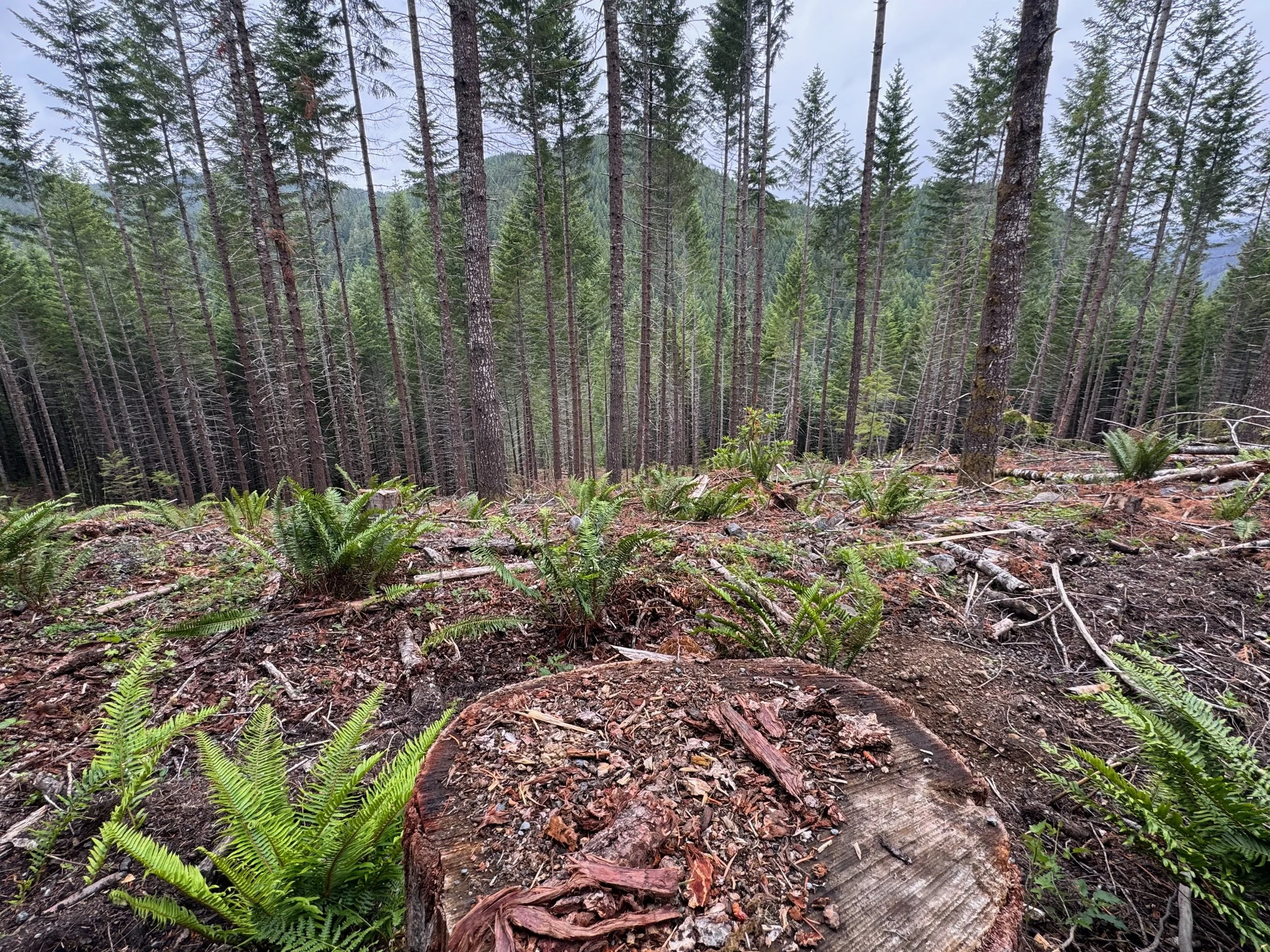
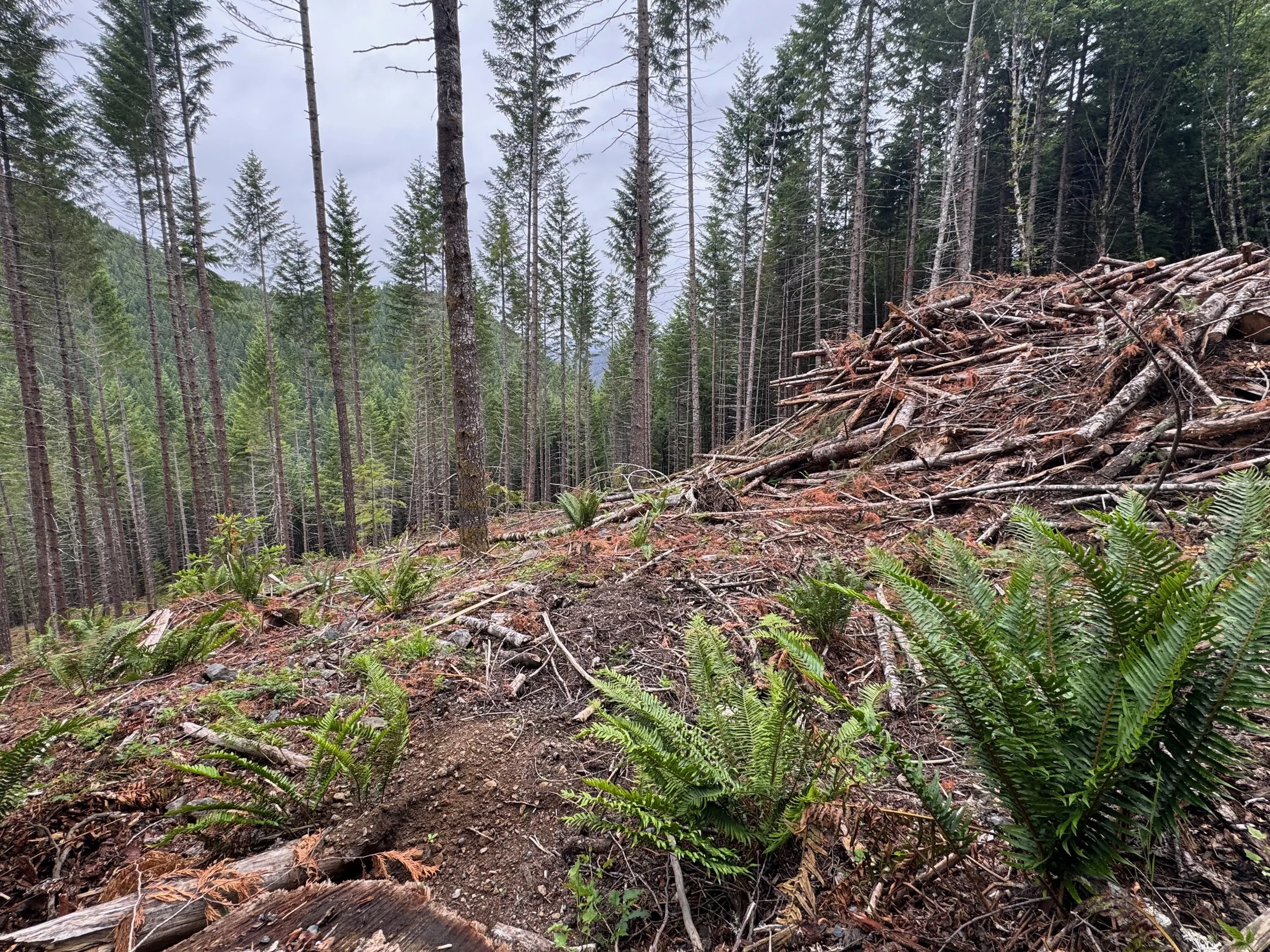
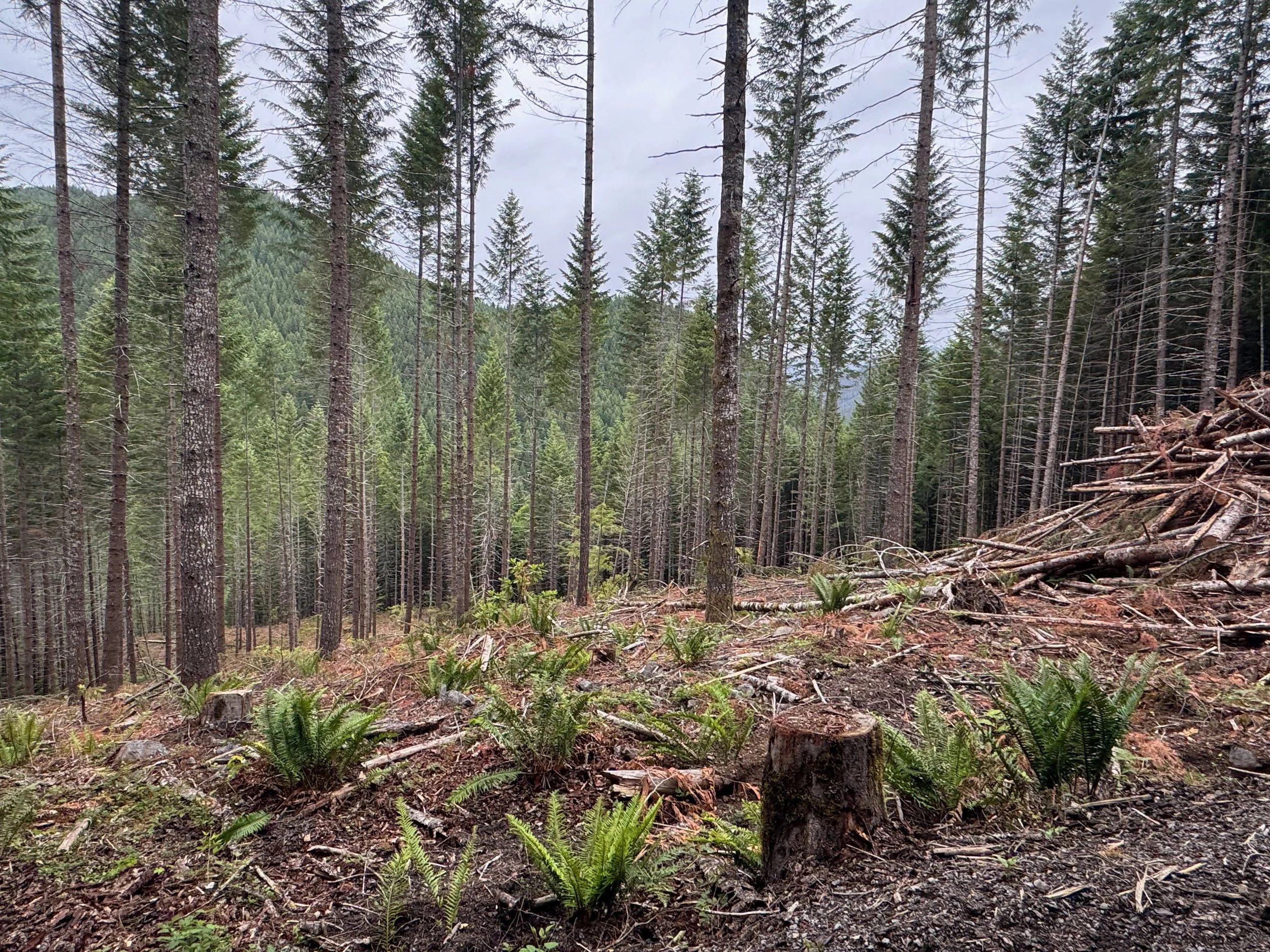
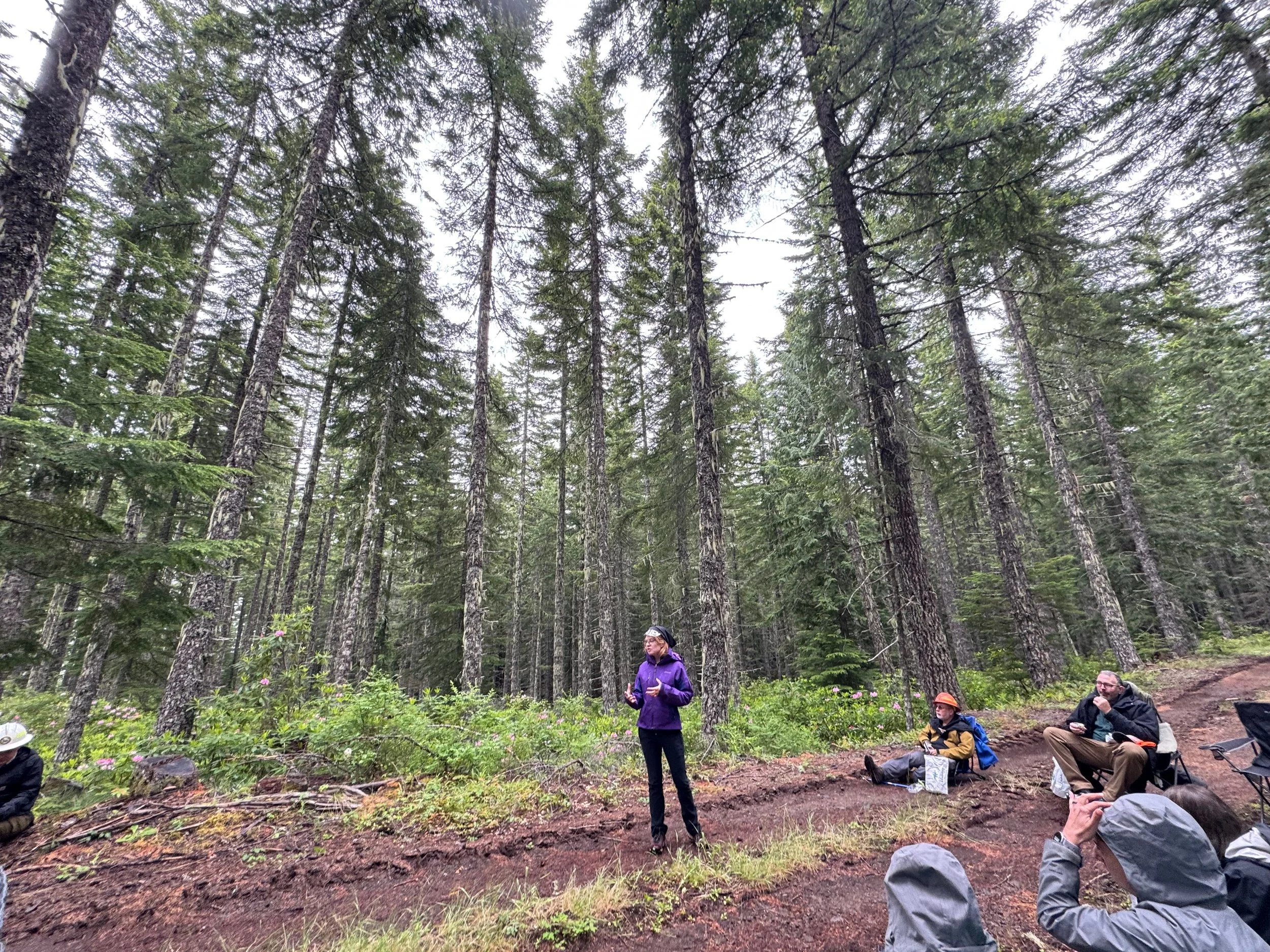
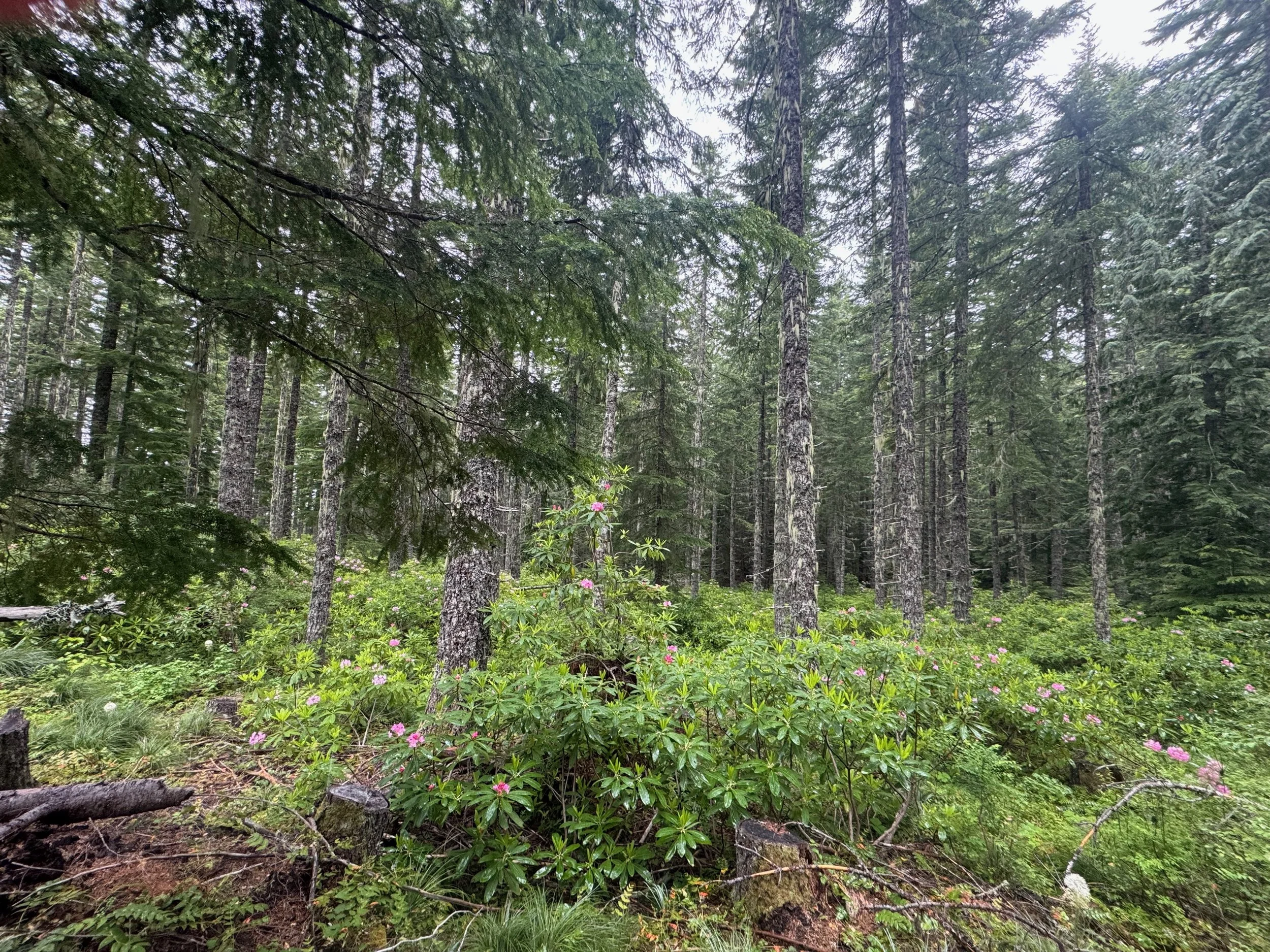
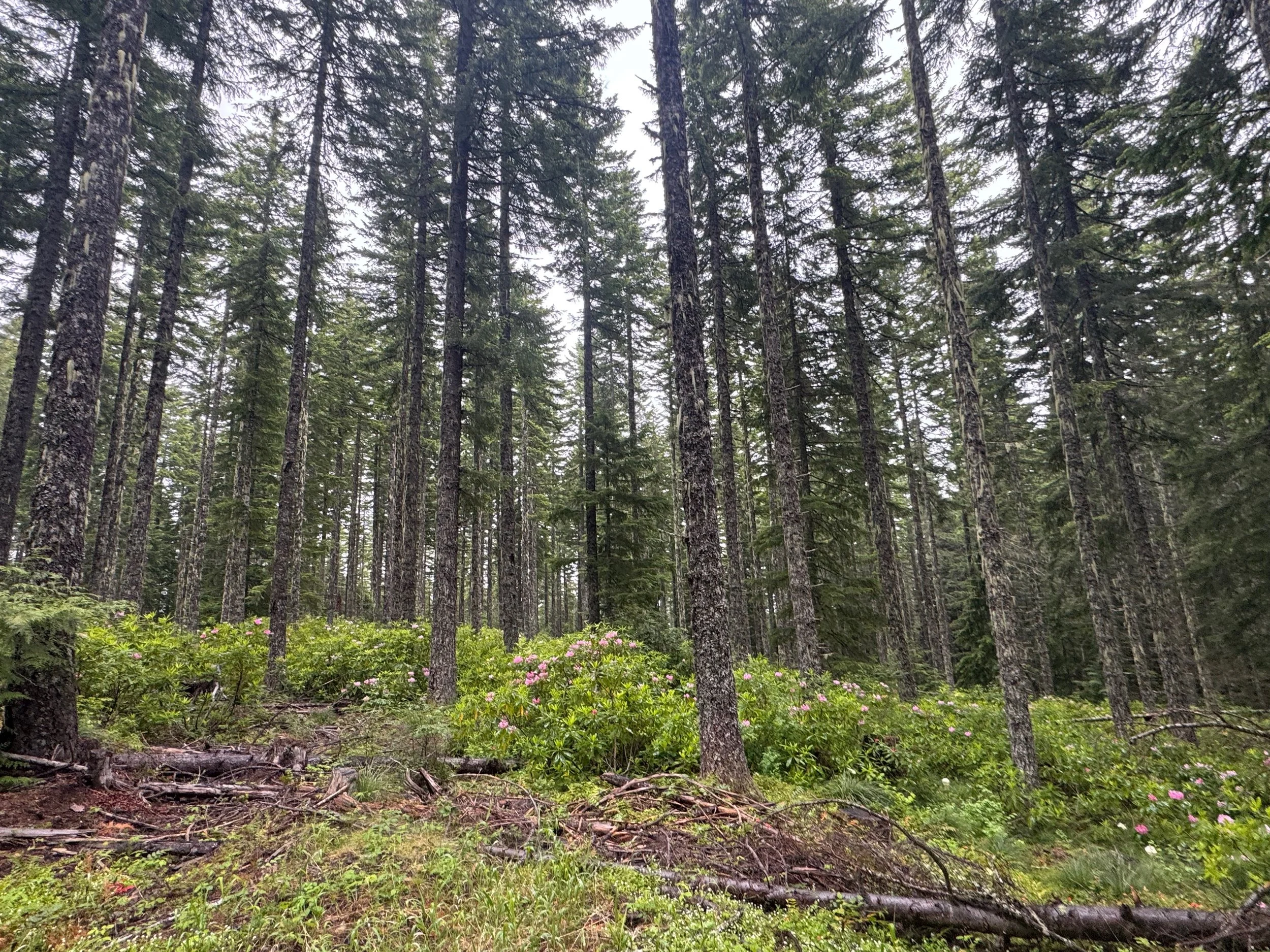
Standing in a 45-year-old plantation at our second field stop — an area that had been thinned from roughly 300 trees per acre to 90 — you could see the difference immediately. Native plants were returning to the understory. The trees left behind were larger, healthier, more vigorous.
This is not a coincidence. It's what happens when management catches up to ecology.



5. Thinning works — and the science on spotted owls is shifting.
The concern that has kept westside forests undertreated for decades is a legitimate one: the northern spotted owl, a federally threatened species, depends on closed-canopy old forest. Active management that opens up the canopy seemed like a direct threat.
We now know the picture is more complicated. A new study by researchers at Oregon State University and the U.S. Forest Service suggests that restoration of landscapes that historically burned frequently through planned, controlled fire does not have to conflict with spotted owl conservation. According to researcher Jeremy Rockweit, "Protecting spotted owls and restoring fire-resilient forests don't have to be competing goals." In fact, if we want to retain spotted owl habitat over time, we need to manage forests in ways that reduce the threat of megafire.
“Protecting spotted owls and restoring fire-resilient forests don’t have to be competing goals.”
This emerging science supports what we saw in the field: areas with a history of disturbance — including thinning — can actually provide better habitat for spotted owls over time than dense, uniform, fire-vulnerable forest. A stand that burns catastrophically in a megafire is not spotted owl habitat. A stand that's been thinned, burned at low severity, and allowed to develop structural complexity is.
The Willamette National Forest is what our Director of Science, Trent Seager, calls "light limited, not water limited." Opening the canopy through thinning allows natural seeding to occur – bringing back the plant diversity that makes these forests productive, resilient, and worth protecting for the long run. Right now, we’re protecting trees in the short term, but putting the forest and all of its benefits at risk of megafire.


6. Prescribed fire on the west side is no longer theoretical — it's working.
For decades, prescribed fire was considered a tool for dry eastside forests, not the wet western Cascades. That assumption is giving way to evidence.
The Willamette National Forest is now actively using prescribed fire in partnership with collaborative groups like South Willamette Solutions. Tribes are being brought in as partners on prescribed fire work. The scientific case is solid: OSU researchers Merschel, Johnston, and colleagues have acknowledged the role of Indigenous fire stewardship in past and present landscapes, and the value of restoring that stewardship to reduce fuels, improve wildlife habitat, increase light to the forest floor, and increase plant diversity.
At the Dry Beard Good Neighbor Authority project we visited – a collaboration between the Oregon Department of Forestry (ODF) and the Willamette National Forest – thinning came first, in 2024. The stand was a Douglas-fir plantation, planted in rows some time in the last century. The prescription cut density from roughly 300 trees per acre to about 90, with two goals: lower fuel loads to reduce megafire risk, and open the canopy to let in more light, encouraging diverse native plants and larger trees. The result is a forest floor where fire can crawl rather than race – lower speed, lower severity. Prescribed fire will follow, reinforcing that health and resilience over time. As Johnston put it: You have to thin and burn to actually change fire behavior – and it has to occur in that order
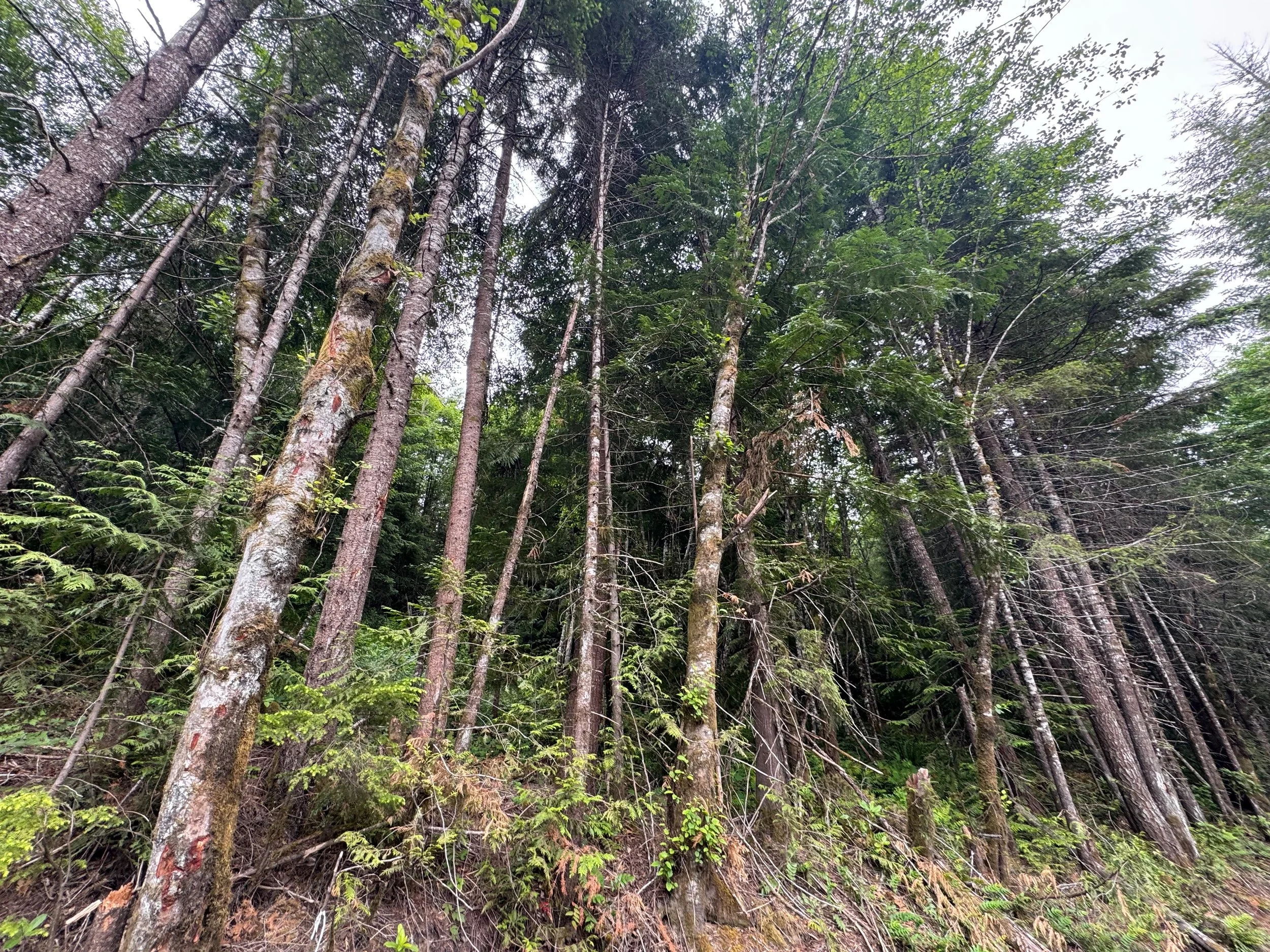
We also visited a thinning project completed in 2014 called the Cub project. Like Dry Beard, it was a commercial thinning project that brought trees from around 300 trees per acre to 100. It never got prescribed fire, which it needed. Smoke management remains a real challenge due to its impact on people in nearby communities.
But the direction is clear: prescribed fire on the west side is coming, and it's necessary.
7. Restoration is good for the forest – and it can pay for itself.
Perhaps the most encouraging thing we heard on the tour: this doesn't have to be a money-losing proposition.
The Dry Beard project generated more timber revenue than anticipated. The minimum bid was $175 per thousand board feet; it sold for $300. Total revenue came in at $2.2 million against a $700,000 minimum. That revenue went back into road repair, ODF staff time, monitoring, and Forest Service capacity. The project, in other words, funded itself – and then some.
The wood from projects like Dry Beard and Cub are also finding a market. Developers and architects are actively seeking to support forest health by procuring wood from sources like restoration harvests. This is particularly reflected in the mass timber sector, a rapidly growing market throughout the U.S.
As part of this interest in supporting forest health, track and trace systems are being piloted by builders to connect forest sources – including thinning projects across Oregon – to specific buildings. Restoration wood from Dry Beard, for instance, is being incorporated into mass plywood panels that are being installed into innovative housing and civic projects across the state, including The Ridge – an affordable housing development consisting of 27 new units in rural John Day.
The virtuous cycle is real: healthy forests, reduced wildfire risk, wildlife habitat, rural jobs, and buildings that store carbon. None of it requires choosing between conservation and management. It requires doing both.
What We Believe
We drove home from the Willamette National Forest with a clearer sense of what's at stake and what's possible.
Westside forests have been largely left unmanaged for decades – not because they didn't need it, but because we built a regulatory and political environment that made management nearly impossible. The result is landscapes that are overcrowded, biologically impoverished, and far more vulnerable to catastrophic fire than they need to be.
The science is no longer ambiguous: thinning restores structural diversity, and prescribed fire reduces catastrophic risk. Partnership between state agencies, federal agencies, Tribes, and collaborative groups makes projects happen faster and more effectively than any single entity could alone. And when it's done right, the economics can work.
The 2020 fires and Johnston and his team’s research should have ended any debate about whether westside forests need active management. The question now is how fast we can move, and whether we have the policy infrastructure, the funding, and the cross-sector will to do it at the scale these landscapes require.
We believe we do. And we're going to keep working to prove it.
Want to learn more about our forest work? Check out our Forest page here.
Want to support our work? Donate here or learn more here.
All photos credits Sustainable Northwest.
